Stop Overthinking and Speak English Confidently | Easy English Podcast
Have you ever been asked a simple question in English, but suddenly your mind becomes completely blank?
You know the words. You know what you want to say. But before speaking, you start thinking about grammar, pronunciation, vocabulary, and whether your answer sounds natural.
Then the moment passes.
This is exactly what we explore in this ESP CLASS podcast episode.
Stop Overthinking and Speak English Confidently is a simple English conversation lesson for learners who understand English but sometimes feel nervous when it’s time to speak.
Why Do We Overthink When Speaking English?
When speaking English, many learners try to prepare every sentence before they say it.
You might think:
- Should I use the present or past tense?
- Is this sentence grammatically correct?
- Am I pronouncing this word correctly?
- Is there a better word?
- What if I make a mistake?
While you’re thinking about all of this, the other person is waiting for your answer.
And the more you notice the silence, the more nervous you can become.
That’s why sometimes your mind is busy, but your mouth is quiet.
Instead of trying to create the perfect answer, start with one simple sentence.
For example:
“What did you do yesterday?”
You don’t need a long story.
You can simply say:
“I stayed home.”
Then continue naturally:
“I watched a movie.”
“Then I made dinner.”
One sentence can lead to the next.
You Don’t Need Perfect English to Have a Conversation
Real conversations don’t require you to use every English word you know.
Simple English can be enough.
If you can’t remember a more advanced word, use an easier one.
For example, instead of searching for a complicated word, you can say:
“It was very good.”
Then add a little more information:
“I had a lot of fun.”
The goal isn’t to sound impressive.
The goal is to communicate your idea clearly.
Sometimes simple English is better than perfect English that never gets spoken.
What Can You Say When You Need Time to Think?
You don’t always have to answer immediately.
If you need a moment, use a natural thinking phrase:
“Let me think.”
“Give me a second.”
“I’m not sure, but…”
These short phrases give you time while keeping you involved in the conversation.
For example:
“What’s the best place you’ve visited?”
You can say:
“Let me think. I really liked a small town near the sea.”
Then continue from there.
A short pause doesn’t mean you’ve failed.
It’s okay to take a moment and think.
What If You Forget an English Word?
Forgetting one word doesn’t mean you have to stop speaking.
Instead, try to describe the word.
Imagine you forget the word “umbrella.”
You could say:
“It’s the thing we use in the rain. We hold it over our heads.”
The other person may understand what you mean and help you:
“Oh, you mean an umbrella.”
You forgot the word—but you still communicated.
That’s an important skill for real-life English conversations.
What If Someone Doesn’t Understand You?
Sometimes people don’t understand us for many reasons.
Maybe the room is noisy.
Maybe they didn’t hear clearly.
Maybe your sentence wasn’t clear.
Instead of repeating the exact same sentence again and again, try using different words.
A useful phrase is:
“Let me say that again.”
Then explain the same idea in simpler English.
For example:
“Excuse me, where is the place where I can send a letter?”
If the person doesn’t understand, you can say:
“Let me say that again. I need to send a letter. Where can I do that?”
The person may then understand:
“Oh, the post office.”
You didn’t need perfect vocabulary.
You simply found another way to explain your idea.
Change the words, not the volume.
Speaking louder doesn’t always make your meaning clearer.
Using different and simpler words often helps much more.
Don’t Judge Your English While You’re Speaking
Another reason learners overthink is that they judge themselves while they’re still talking.
You say something and immediately think:
“Was that grammar correct?”
“My pronunciation sounded strange.”
“Why did I use that word?”
But while you’re thinking about your previous sentence, you may miss what the other person is saying.
During a conversation, try to focus on what the other person means and what you want to communicate.
You can think about your mistakes later.
Speaking time doesn’t have to be test time.
A conversation is about communication and connection.
Start With One Sentence
One of the easiest ways to reduce overthinking is to stop planning the entire conversation.
You don’t know exactly what the other person will say anyway.
Instead:
Start with one sentence.
Then listen.
Then answer the next question.
Then continue.
For example:
“What do you usually do on weekends?”
“I usually visit my brother.”
The other person might ask:
“Does he live near you?”
You answer:
“Yes, he lives about 20 minutes away.”
Then the conversation continues naturally.
You didn’t prepare every sentence.
You simply listened and responded.
That’s how real conversations work.
A Simple English Speaking Practice
Try this practice after listening to the episode.
Choose one simple question:
“What did you do today?”
Now speak for about 20 seconds.
Don’t write your answer first.
Don’t prepare every sentence.
Just start.
For example:
“Today I went to work. I had lunch with my friend. After work, I came home and watched a movie.”
Your answer doesn’t need to be perfect.
It just needs to communicate something real.
You can also practice with:
- What do you like doing after work?
- What did you eat today?
- What do you usually do on weekends?
- What’s your favorite place?
- What did you do yesterday?
Start with one sentence and let the answer grow naturally.
The Main Lesson
You don’t need perfect English to speak confidently.
You can:
Pause.
Use simple words.
Correct yourself.
Forget a word and describe it.
Ask someone to repeat something.
Make a mistake and continue.
The important thing is not to let one small mistake stop the whole conversation.
Your English doesn’t have to be perfect before you start speaking.
You improve your speaking by speaking.
🎧 Listen to the Full ESP CLASS Podcast
Want to hear these ideas through a natural, slow English conversation?
Listen to the full episode:
Stop Overthinking and Speak English Confidently | Easy English Podcast
👉 Listen to this episode on YouTube:
🎙️ More ESP CLASS Podcast Episodes
If you’re enjoying the ESP CLASS podcast, you can also listen to our previous episodes and practice English through simple real-life conversations.
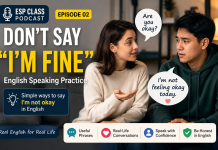
Episode 1 — Don’t Say “I’m Fine” | English Speaking Practice
Learn simple and natural ways to respond when someone asks, “Are you okay?” and practice useful English for expressing how you feel.
👉 Listen to Episode 1 on YouTube
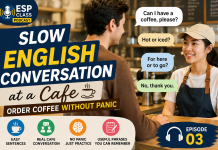
Episode 2 — Slow English Conversation at a Cafe | Order Coffee Without Panic
Learn simple English phrases for ordering coffee, answering questions at a café, and handling a real-life coffee order with confidence.
👉 Listen to Episode 2 on YouTube
Episode 3 — Don’t Say “I’m Fine” | English Speaking Practice | ESP CLASS Podcast
Practice useful English through another slow and natural conversation designed for real-life situations.
👉 Listen to Episode 3 on YouTube
Episode 4 — Forgot a Word in English? Try This!
What happens when you know what you want to say but suddenly forget one important English word?
Learn how to describe something using simple clues and keep the conversation going instead of freezing.
👉 Listen to Episode 4 on YouTube
📚 Keep Learning With ESP CLASS
ESP CLASS focuses on simple English for real life—the kind of English you can actually use when talking to people.
Listen to the podcast, repeat the useful phrases, and practice speaking without worrying about being perfect.
👉 Listen to the ESP CLASS Podcast Playlist
Keep listening. Keep practicing. Keep speaking.
Your goal isn’t to speak perfect English.
Your goal is to keep the conversation moving.