🎙 Podcast Episode 01
Mind Goes Blank in English?
What to Say When Your Brain Suddenly Stops Working
Have You Ever Felt This?
Imagine this.
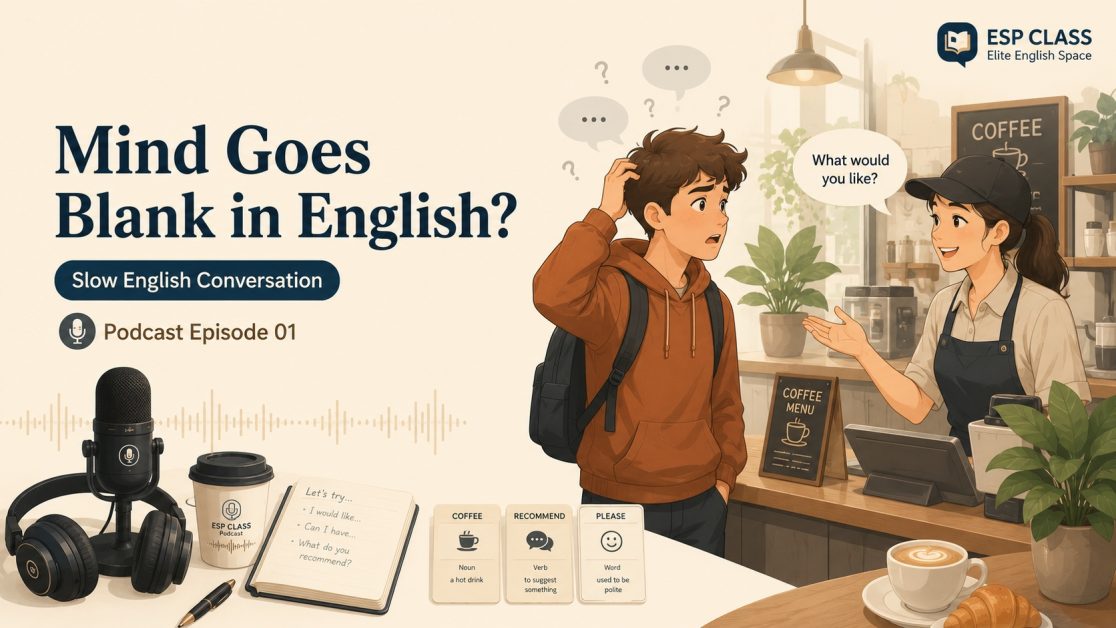
You’re standing in a coffee shop.
You already know what you want to order.
You’ve practiced the sentence in your head several times.
“Can I have a small coffee, please?”
Everything feels easy.
Then the cashier smiles and asks,
“Hi! What can I get for you?”
And suddenly…
Nothing.
Your mind goes blank.
You know English.
You studied English.
But at that moment, the words simply disappear.
If this has happened to you, don’t worry.
You’re not the only one.
Almost every English learner experiences this at some point.
Why Does This Happen?
Many learners think,
“Maybe my English isn’t good enough.”
But that’s usually not true.
Most of the time, your English hasn’t disappeared.
Your brain has simply become nervous.
When someone is waiting for your answer, your brain starts looking for the perfect sentence.
While it’s searching…
Everything suddenly feels empty.
The problem isn’t your English.
The problem is pressure.
A Small Pause Can Save a Big Conversation
One of the most useful things you can learn is this simple sentence:
Give me a second.
It gives your brain time.
It gives your mouth time.
And most importantly…
It helps you stay inside the conversation instead of giving up.
Try saying it out loud.
Give me a second, please.
Simple.
Natural.
Useful.
Five Rescue Sentences Every Learner Should Know
When your mind goes blank, these small sentences can help you continue speaking.
1. Give me a second.
Use it when you need a little more time.
2. Let me think.
Perfect when someone asks you a question.
3. I forgot the word.
Don’t stop the conversation.
Simply tell the other person.
4. Can I say it another way?
You don’t always need the perfect word.
Use simple English instead.
5. Let me start again.
Made a mistake?
No problem.
Take a breath and begin again.
Let’s Imagine a Real Situation
You’re ordering coffee.
The cashier asks,
“What can I get for you?”
Your brain suddenly becomes empty.
Instead of staying silent, you smile and say,
“Give me a second, please.”
You look at the menu.
You take one deep breath.
Then you say,
“Can I have a small coffee, please?”
That’s it.
The conversation continues.
No panic.
No embarrassment.
Just one simple sentence that gave you enough time.
You Don’t Need Perfect English
Many learners stop speaking because they forget one word.
But remember…
Forgetting one word doesn’t mean the conversation is over.
Imagine you forget the word umbrella.
Instead of becoming silent, you can simply say,
“I forgot the word, but I mean the thing you use when it rains.”
The other person will probably smile and help you.
Communication is more important than perfection.
Practice Time
Read these sentences slowly.
✔ Give me a second.
✔ Let me think.
✔ I forgot the word.
✔ Can I say it another way?
✔ Let me start again.
Now close your eyes.
Imagine yourself in a real conversation.
Can you use one of these sentences?
If yes…
You’re already improving.
Remember This
A blank mind is not failure.
A pause is not failure.
Making mistakes is not failure.
Giving up is the only thing that stops your progress.
Simple English is still real English.
Every conversation teaches you something new.
So don’t wait until you’re perfect.
Start speaking.
Even if it’s slow.
Even if you need a few extra seconds.
Key Takeaways
✅ Your English doesn’t disappear—your confidence does.
✅ A short pause is completely normal.
✅ Rescue sentences help you stay in the conversation.
✅ Simple English is powerful English.
✅ Confidence grows through practice, not perfection.
Continue Learning
If you enjoyed this lesson, don’t stop here.
🎙 Listen to the complete conversation in our YouTube podcast, where Emily and Albert explain these situations through a slow, natural, and beginner-friendly English conversation.
There, you’ll hear real dialogue, useful expressions, and pronunciation practice to help you build confidence step by step.
👉 Watch Podcast Episode 01 on the ESP CLASS YouTube Channel and continue your English journey.